NEWS | EVENTS | VENDORS | SUCCESS STORIES
ABOUT PORTAL | SPONSORS | CONTACTS
|
|
|
|
|
|
| RUSSOFT | INSIDE RUSSIA | WHY RUSSIA | GUIDES & TIPS | GLOBAL OUTLOOK NEWS | EVENTS | VENDORS | SUCCESS STORIES ABOUT PORTAL | SPONSORS | CONTACTS |
|
|
|
|
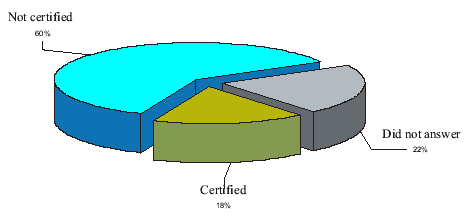
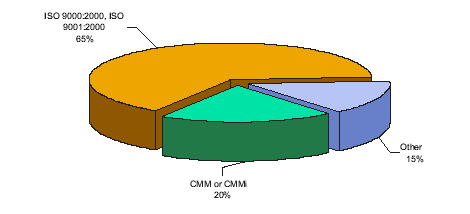
Third Annual Survey on Russian Export Software MarketQuality management certification systemRussian companies' lack of quality management certification to international standards was until 2002 a major reason for Russia's low ratings in surveys published by leading analysts - surveys that most foreign clients read as a matter of course. After having realised this, many companies - mainly larger firms with turnover of at least $3 mln - started to undergo international certification procedures. As a result the situation changed. Whereas four years ago certification to the sectoral CMM standard (CMMI after 2004) had been obtained by only two companies, by the start of 2006 this figure had risen to 10. Several Russian exporters are undergoing certification at present or are planning to do so in the near future. However, it is still premature to talk of a mass phenomenon. According to RUSSEE, more than 500 companies in the U.S. are certified to CMM (CMMI) standard, and in India more than 140. Japan and China also post large numbers, with over 120 each. CMMI certification is in most cases a passport to participation in major tenders. Almost all major Russian software exporters who do not have CMMI certification have certification to ISO 9001 standards, which are applicable to various sorts of business. Getting even a small contract in Europe without ISO is difficult. Some 60 companies in Russia have ISO certification. In total, roughly 6% of Russian exporters have already undergone certification. Figure 42. Quality management certification, %. Figure 43. Distribution of quality management systems by standard, %. Given that exporters with under 300 employees (in most cases Russian companies that attain this level start to undergo certification) make up less than 10%, then it is understandable why introduction of quality management systems is a major trend for fewer survey respondents compared with previous years. More than 60% of companies with turnover of over $3 mln already have some sort of certification (of the 17 largest companies who returned forms, only four have no certification, and three did not answer the question).
Among survey participants, the number who saw introduction of certification as a major trend dropped compared with last year, from 54% to 33%. Only 23% of respondents said introducing these systems was a major activity area for their company. Thus, we can say that the certification problem is not as pressing as it was a year ago, and even less so than in 2002. Most major companies already have some certificate, and small companies (both by personnel numbers and by turnover) are dealing with higher priority problems or do not have the resources necessary to invite in consultants and undergo CMMI certification. However, some smaller companies with turnover of under $0.5 mln (four firms) have undergone ISO 9001 (or 9000) certification. In relative terms this is quite a small quantity (only 4%). Nevertheless, in some cases even small companies are able to pay consultants and pay for certification to ISO 9001 standard (or ISO 9000, which only one survey respondent had), and see the need to have it. CMMI certification with all its various assessment procedures costs many times more than ISO 9001. In Russia, the cost of outsourcing services alone given primary CMMI certification starts at $10,000-$12,000. Overall spending can be much higher, and depends on the size of the company and the state of its management system at the start. CMMI certification could be accessible to a majority of Russian companies, if Russia had national authorized appraisers. Currently, all consulting, educational and certification work for Russian software developers is done by foreign professionals, whose services are expensive. Only two companies in our survey had more than one certificate: One had ISO 9001, ISO 27001:2005 and CMM 5; and the other had ISO 9001:2000 SMMI 3 Level. Another three respondents did not select any of the options available. They had certification to IBM standards (IBM xSeries, pSeries, and zSeries), MCP and GOST R ISO 9001-2001. Several Russian companies have independently introduced quality management systems based on ISO 9001 or CMMI and prove their compliance with international standards to individual clients. This brings them substantial savings on having to pay for firms authorized to carry out certification. This is another reason why quality management systems are for most respondents not a major task or problem. Nevertheless, the problem has only receded, and the issue remains unsolved. In China and India the number of companies with CMMI certification is much larger. In addition, the survey results show that only 20% of large companies (turnover of more than $3 mln) have CMMI or CMM certification, while 40% preferred ISO. Among companies with smaller income, none have yet obtained certification - even though 80% have clients in the United States and 40% say the American market is key. 40% of large companies also do not have any certification. Even so, most Russian companies would prefer first to grow (by personnel numbers and turnover) to a given size and business process organization level before formalizing their quality management system and obtaining official international certification. On the other hand, certificates are an additional trump card in the struggle for clients, if for a project it is possible to take on new employees and grow that way (although of course the basic organizational skeleton should be there already). For this reason it is not just the largest uncertified companies but even smaller companies with turnover of under $0.5 million that intend to obtain certification in the next two years. Of the 69 uncertified respondents, 35 companies (51%) have certification plans. In 2006, nine respondents (13%) plan to obtain some form of certification in 2006, and 26 (38%) in 2007. In other words, in two yeas the number of uncertified companies should shrink by 50%. Another 23 respondents (33%) plan to undergo certification, but not in the near future.
Thus, only 16% of companies say they do not need certification, and most of these are small companies. Most likely, several of them see no possibility to undergo certification in the foreseeable future, and prefer not to build longer-term plans. Certification is also not considered that important by companies specialized on producing their own products. Nevertheless, the decision by larger companies that in all probably have the means for it to reject certification shows that some Russian developers can get along fine without ISO and CMMI. These are primarily box/license companies, which currently make up about 10% of midsize and large companies. 92% of midsize companies (turnover of $0.5-3 mln) that have no certification plan to obtain it not in the next two years but some time later. Such companies also account for 85% of the smallest firms. Midsize companies are currently the most likely to note the importance of obtaining certification. 36% percent of respondents from firms with 35-120 employees said that introducing quality management systems to international standards was a priority area (the industry average was 23%). 20% of companies with under 35 employees acknowledge the significance of this area. For the smallest companies the indicator is lower, at 12%. The state should be in a position to help increase the number of Russian firms with ISO or CMMI certification. However, currently it is providing no support to the industry in this sphere. Companies representing the sector say that such support is one of the least significant measures that the state should be undertaking. Further evidence of this can be found in RUSSOFT's October 2005 survey, in which large and small companies ranked quality management systems last of all forms of assistance they expected from the state. Of greater importance for Russia's software industry are problems of the tax regime, personnel training at state higher educational institutions, international marketing, administrative barriers and available telecommunications infrastructure. One possible reason for the current low rating of state certification support is that the share of certified companies in the sample of last year's survey was quite high (62%), and naturally these companies do not really need state support in this sphere. The number of certified companies in the current survey was much lower. Therefore most of them (83%) rated state support as poor, 16% said it was only satisfactory, and a tiny 1% said it was good. |
|
  





|
|
|
|
|
|