NEWS | EVENTS | VENDORS | SUCCESS STORIES
ABOUT PORTAL | SPONSORS | CONTACTS
|
|
|
|
|
|
| RUSSOFT | INSIDE RUSSIA | WHY RUSSIA | GUIDES & TIPS | GLOBAL OUTLOOK NEWS | EVENTS | VENDORS | SUCCESS STORIES ABOUT PORTAL | SPONSORS | CONTACTS |
|
|
|
|
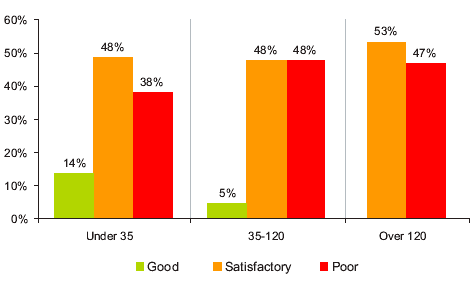
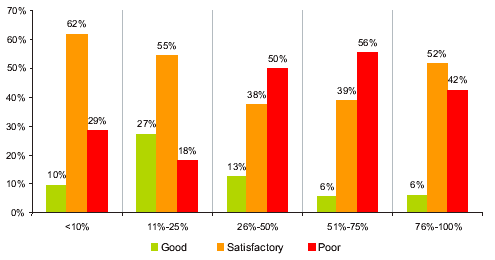
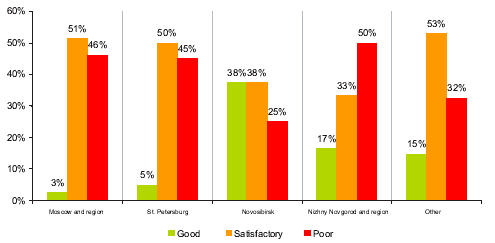
Third Annual Survey on Russian Export Software MarketHR situationAs mentioned above, only 10% of respondents said they had no problems with personnel supplies. These were the smallest companies, with under 35 employees (14%) and companies with 35-120 employees (5%). Major companies unanimously said they were unhappy with the HR situation (47% of respondents said the situation was bad, and 53% said satisfactory). It seems that larger companies run into certain difficulties when attempting to boost their employee numbers significantly. The smallest companies, for the most part, cannot even dream of bringing on dozens of new professionals, and finding a few extra people, if necessary, is not that difficult. Figure 35. Assessment of the personnel market by number of employees. Usually, demand for employees is higher among companies oriented to the external market. This is because exporters are largely unsatisfied with the relatively small share of income received from Russian customers. At least half of companies for whom exports make up 26-75% of income say that the personnel situation is poor. Companies that gain nearly all their income from exports are even less satisfied. It seems that they are better able to offer their employees better salaries, because these companies are well established on foreign markets. Nevertheless, this group expressed far more dissatisfaction with the HR situation than companies that pull in up to 25% of their income from exports. Figure 36. Assessment of the personnel market and education system by share of export in turnover. The personnel problem is most keenly felt in Moscow and St. Petersburg, as might have been expected. Only 3-5% of companies in the two major cities rated the situation good, 50-51% said it was satisfactory, and 45-46% said it was poor. Figure 37. Assessment of the personnel market and education system by company location. The situation on the Petersburg labor market has noticeably deteriorated over the last two years. Petersburg has seen the opening of development centers by companies including Sun Microsystems, Intel, and Alcatel. In addition, Motorola and Borland - which opened their own software subdivisions even earlier - are also competing for Petersburg professionals, and have been looking more proactively to take on more employees recently. A Siemens development center has been functioning in the city for a long time, but it is not expanding particularly rapidly. In addition to well-known foreign companies, firms like Luxoft and Epam systems, some of the largest software developers in the post-Soviet space, also play a role. They have also opened offices in St. Petersburg over the last two years, and started to headhunt employees. In the same period, the local company StarSoft Development Labs has also grown quickly. In the last two years, at least 1,500 vacancies have appeared at these eight companies alone (except Siemens). This is quite tangible, given that about 8,000-10,000 highly qualified professionals are working on the St. Petersburg software production export market as a whole. Petersburg universities produce some 5,000 graduates annually in specializations that mark them out as potential programmers. Of these, 500 go straight into the sector, and another 1,000 or so undergo additional training before filtering into the industry, while the rest find work in other sectors. In their turn, company managers say that another 1,000 engineers are needed annually to maintain growth. Naturally, average wages for these professionals have shot up. Wage growth has been at least 25%, but in some short-staffed specializations this figure can be 100%. In Nizhny Novgorod and the surrounding region, the situation is even bleaker, apparently because of the large intake of personnel at the Intel development center. The situation in Novosibirsk and other cities is much better. It is no accident that personnel training was ranked second among frontline measures of state support needed in the survey carried out by RUSSOFT in October 2005. Obviously, the state education system is not reacting flexibly enough to market demand for high-class professionals in the software development industry. Exporters note a need for state support for centers of post-graduate training.
|
|
  





|
|
|
|
|
|