NEWS | EVENTS | VENDORS | SUCCESS STORIES
ABOUT PORTAL | SPONSORS | CONTACTS
|
|
|
|
|
|
| RUSSOFT | INSIDE RUSSIA | WHY RUSSIA | GUIDES & TIPS | GLOBAL OUTLOOK NEWS | EVENTS | VENDORS | SUCCESS STORIES ABOUT PORTAL | SPONSORS | CONTACTS |
|
|
|
|
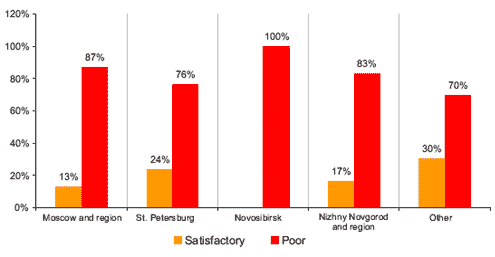
Third Annual Survey on Russian Export Software MarketState support for international marketing activityCompared with overall state support for international marketing worldwide, the situation in Russia is far behind. The only instances of financial support in the IT sector are the financial involvement of the Education and Science Ministry's stand at CeBIT over the past 11 years, financing from the Ministry of IT&Communications of the Russia collective pavilions at the same exhibition in 2005, 2006, and events to promote the Russia@CeBIT brand in 2005-2006. CeBIT is the only global IT event to make it onto the plan of the Interministerial Commission for Exhibition Activity which acts under the auspices of the Ministry of Economic Development and Trade. As well as financial support there is some PR help, especially in the past two years, when the president and the Ministry of IT& Communications have made a number of favorable declarations about the software industry. Such statements by regional heads, mayors, governors, and the head of state have produced a favorable impression and serve as advertising for Russian software companies. High-level declarations of moral support for export software development also act positively on bureaucrats at all levels, who refrain from throwing obstacles in the way of foreign IT companies growing their business in Russia. Representatives of foreign companies say state support for the sector is a major factor in launching collaboration with Russian partners and opening development centers in Russia. Despite notable PR for the sector from the state, software company managers questioned do not rate state support as a whole very highly. 80% of respondents said it was poor, and only 20% satisfactory. Of all forms of state support (or state policy areas), the effect of software exporters' international marketing activities was seen by respondents as currently the least effective measure. In September 2005, the average rating was roughly the same, but with a larger range - from very bad to good, although this latter was assigned by only 2% of respondents. There is no obvious correlation between assessment and company size, or assessment and share of export in total turnover. Petersburg companies are almost twice as satisfied as those in Moscow. This may be because RUSSOFT, which is based in St. Petersburg, always underlines the presence of state support. It may also be the case that city leaders (primarily Governor Valentina Matviyenko) say that St. Petersburg is Russia's IT capital, and refer to the opening of new international development centers and talk about the creation of a network of IT parks. Unfortunately, this has no effect on marketing support for Petersburg companies. In particular, St. Petersburg's image took a hit with the city's stand at CeBIT 2006, which showcased no single software development company. Overall, assessments of state support in Petersburg are nevertheless lower, with 24% of respondents in the city expressing satisfaction. The rest rated marketing support at 2 out of 5. The rating was of marketing support from all state organs (mainly at the federal level). Figure 41. Assessment of state marketing support by company location. The high level of dissatisfaction among Moscow companies is the result of their higher demands on state marketing support and a complete lack of it from Moscow city authorities. Respondents from Novosibirsk noted a similar absence, and unanimously graded support as bad. We can say that this opinion is both an attitude to the position of local authorities and also an appeal to the federal center, which has not paid serious attention to regional companies. It is slightly surprising that other cities are more patient (31% of respondents said support was satisfactory). This is probably because these respondents do not have reliable information and are basing their opinions on media reports. However, in any case a low opinion of state support prevails throughout, with no correlation to company location, and the deviation from the average across Russia is very slight. The results of RUSSOFT's rating survey of state support measures for IT products and services exports carried out in October 2005 showed that software companies see marketing support from the state as less important than the personnel training problem and reducing tax and administrative barriers. Nevertheless, such support was rated as a priority by 30% of companies questioned. These were mainly large companies that already invest significant amounts of money in promoting their products and services on the global market (marketing budgets may be as much as 15% of company spending) and see how other states support their competitors' marketing efforts. For smaller companies, activity on international markets given a complete lack of state support is premature and economically unsound. They do not have the financial, time, or human resources to take part in international events. Nevertheless, the spring survey shows that both small and large companies are equally unhappy with state marketing support. |
|
  





|
|
|
|
|
|