Interview: Vyacheslav Mukhortov
Inteks
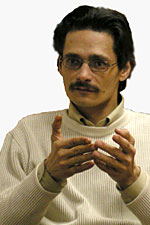 Vyacheslav Mukhortov: "The high concentration of scientific, technical, and educational potential at Novosibirsk's Akademgorodok can only help the development of the IT sector."
Despite its geographical remoteness from Western clients, Novosibirsk has become a major Russian center of software development for export. The general director of Novosibirsk firm Inteks, Vyacheslav Mukhorov, told Computerworld correspondente Dmitry Zhelvitsky about how firms far from Moscow are able to grow and develop.
Many in Russia know about the success of Novosibirsk's Akademgorodok. How has it helped development of the software sector in your city?
Novosibirsk's Akademgorodok is a unique location, where Novosibirsk State University is located in a picturesque pine forest 30 km from the center of Novosibirsk, along with more than a dozen academic institutions of the Siberian department of the Russian Academy of Sciences. Naturally, this high concentration of scientific, technical and educational potential can only help the development of the IT sector. Novosibirsk State University, one of Russia's largest, trains professionals who are known for their high level of training both in Russia and abroad, in the sciences and technical subjects, including programming. We should also note a peculiarity of the NSU educational process, namely that the percentage of fulltime professors is very low, and most teachers in major disciplines are employees of academic institutes - i.e., professionals who work directly at the cutting edge of the discipline being taught. This principle was used when the IT faculty was created at NSU a few years ago. Knowledge in specialized disciplines is imparted by senior experts at local IT companies who have great practical experience, which creates fertile ground for training highly qualified professionals for our sector.
A top professional doesn't always become a good teacher. Are there enough people who can lecture well?
It's true that far from all professionals can become as good teachers as they are managers. But the time of individual super-programmers in the IT sector has long gone. Quality project management is already unthinkable without effective knowledge sharing, and a really good professional should be able to share knowledge. Therefore we view teaching as an important component of our professionals' career growth.
In Novosibirsk there are enough companies that recognize the importance of training young personnel, and that are ready to spend time and money on this, so it is possible to find one lecture for each course from among hundreds of good professionals. Many managers and IT professionals will willingly work with students, read lectures, take practical classes and oversee development of coursework and diploma work. Inteks is also involved in the academic process. Five of our employees are already teaching courses developed by employees of our company on object-oriented programming, object-oriented analysis and design, and IT project management. Every year we take on students for work experience, and from senior years we present project work done for the company's internal needs.
Without close collaboration with the university, further development of the hi-tech sector, including software, would be impossible.
If the IT faculty at NSU only appeared a few years ago, how come there are so many software companies in Novosibirsk working with foreign clients?
The faculty didn't spring up in the desert - Novosibirsk has had a programming school for ages. The founder of Akademgorodok, M.A. Lavrentyev, was involved in early Soviet computer building, and A.P. Yershov, one of the founders of the theoretical programming school, worked here as well. Akademgorodok is also home to institutes of the Russian Academy of Sciences' Siberian division, including the Mathematics Institute, the Computing Center, the Institute of Computing Technology, and the Institute of Informatics Systems, that have produced a number of employees of current IT companies who graduated from the NSU math and mechanics faculty.
In addition, a large number of qualified professionals came into the Akademgorodok and Novosibirsk IT industry from the NSU physics faculty via training in Academy of Sciences' institutes like the Nuclear Physics Institute, the Automation Institute, and other physics-based institutes that had great demand for fairly complex software. For example, I myself worked for eight years at the Nuclear Physics Institute, where I was involved in automization of physics experiments, and then moved to a custom software development company.
It's sad, but the establishment of the IT industry has largely happened due to an outflow of personnel from science, as a result of low salaries. On the other hand, the appearance of the industry has stopped an outflow of some personnel from science going abroad. Many of those who at one time or another worked on scientific software development preferred Silicon Vally to Siberia's Silicon Taiga. Graduates of the physics and math faculties at NSU are filling up the IT labor market even now, but even so the appearance at the university of a specialized IT faculty is very timely. I can't say that the IT faculty program is ideal, but it does include experience of other faculties and is better suited to the needs of industrial programming.
How do outdated educational standards hinder training of professionals?
State standards for IT specialists are not that old - they were ratified in 2000 and include scope for disciplines established by higher educational institutions, elective disciplines and independent study defined by the faculty. Compulsory sections are not so strict that they make creation of a quality educational program impossible. The founders of the IT faculty spent at least a year arguing over the contents of courses and distribution of educational load, but the program overall meets the standards. If there was something to argue about, it means there was a high enough degree of freedom.
It's not the standards that get in the way, but outdated educational programs at many institutions where the government is spending time and money on thousands of graduates. For all the virtues of the Russian higher education system, the need for a graduate to complete his studies on arrival in industry was a commonplace. Of course, thanks to a good basic, universal education for math, physics and other graduates, good IT professionals can be trained during the work process from now on. However, this form of professional training is not profitable on an industrial scale, especially if there is a need to raise industry growth rates at a national level.
There is definite progress in the necessary area, but from talking to prospective employees I can say that programming training is outmoded at many Russian educational institutions. To this day you can meet programming languages from the 1970s, which although theoretically interesting are no longer used in real life. At the same time, several industry necessities - like object-oriented analysis and design, IT project management, and marketing - are often totally missing from educational programs.
We should also remember the traditionally insufficient knowledge of English in technical specializations. Self-teaching takes a long time and not everyone can do it; similarly for learning from one's own mistakes. As a result, yesterday's student either spends a lot of time and money on paid courses, or makes mistakes at work.
The state is planning to allocate budget funding on construction of technoparks in several Russian cities, including Novosibirsk. What do you think of this idea?
Of course I'm happy about the planned construction of a new building for the university and new rental space as part of the technopark, but several aspects of the idea - at least in the way it's been covered in the press - produce more questions than excitement. For example, they say that production volumes at the technopark should be several million dollars from the very get-go. By the standards of the custom software development market (which is not the cheapest of the areas planned to be nurtured at the technopark), to get these volumes will require a client portfolio the equivalent of a good 10,000 man-years. Which marketing resources are planned to be used to get these volumes are as yet unknown. They also say that the technoparks will employ thousands or even tens of thousands of professionals. Where are these people working now? If at present they are working in hi-tech sector companies, then there is no real point in the state building this park. Maybe some HE institution or other will train them all by 2008? Rank and file programmers and testers can be trained in 4-5 years, and you can't get far without these professionals. Even now the market has a shortage of managers at lower and middle levels - project managers and architects, and sales managers, who need years of experience after finishing university. We'll wait and see, of course, but at the moment the hullabaloo around the technoparks is raising a number of questions.
Can some problems regarding personnel in key positions by inviting professionals and managers from other Russian towns, from abroad or from other sectors?
In several categories, such as marketing, inviting professionals from abroad who have knowledge of target markets is a possible solution. As far as I know, inviting such professionals directly to work in Russia is not a mass thing, and most companies use the services of foreign intermediaries to look for clients. This is also a normal solution: Development is outsourced to us, we outsource client searching. Inviting managers from other sectors, in my experience, gives good results, but rarely and slowly - the IT sector has many specifics.
How can Inteks and other software companies and the sector as a whole up growth rates?
Speaking for ourselves, we see great potential growth in strategic partnerships with major IT service deliverers in the West and in Russia. For the sector as a whole of great interest is the development of its own IT boxed products, which by comparison with custom development or the service model bring in higher profits, although they need long-term investment. In this venture funds and targeted investment from the state could help. Interestingly, venture capital in Europe is already showing interest in the Siberian IT sector, although currently not in significant volumes.
Does Novosibirsk anticipate the creation of subsidiaries of major Moscow and Petersburg software firms?
As far as I know, several companies from Moscow and St. Petersburg already have branches in Novosibirsk, although this is not a mass phenomenon. I suspect that major companies from these two cities should be interested in another option - secondary outsourcing - since outsourcing part of a project means outsourcing risks, overheads, and staff problems. Concentrating on marketing, which by virtue of proximity to Europe and major Russian clients' head offices brings these companies greater profits than spending resources on managing distributed infrastructure. This process is already ongoing and several Moscow firms are already giving some software development work on large projects to partners in Novosibirsk.
What support do you want from the state?
I don't think I can say anything special about this question. Like everyone, we want a proper tax system. It's not a secret that IT outsourcing expenditure and salaries make up far from 5-10%, say, of income in natural resources sectors. In the end, taxes taken out of the salary fund are a major tax burden for developing companies. In this connection the draft bill considered by the State Duma on removing income tax for IT companies, as well as property tax and a single social tax, and replacing them with a fixed 6% tax rate, is very hopeful. However, the strange limitation on a minimum number of employees (over 100 people) makes it useless for small growing companies, which would be better off with a simplified tax system.