NEWS | EVENTS | VENDORS | SUCCESS STORIES
ABOUT PORTAL | SPONSORS | CONTACTS
|
|
|
|
|
|
| RUSSOFT | INSIDE RUSSIA | WHY RUSSIA | GUIDES & TIPS | GLOBAL OUTLOOK NEWS | EVENTS | VENDORS | SUCCESS STORIES ABOUT PORTAL | SPONSORS | CONTACTS |
|
|
|
|
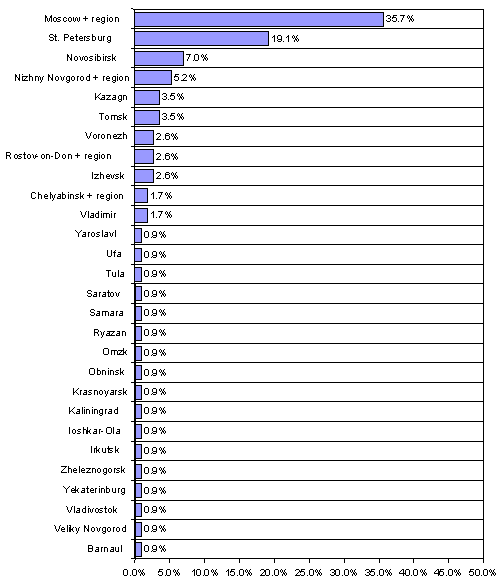
Third Annual Survey on Russian Export Software MarketLocation of head and local officesThe number of completed response forms from each location in part depends on chance factors, so the level of representation of various regions taking part in the survey reflects the distribution of exports by location with a certain margin of error. Nevertheless, there is a certain correspondence between these different distributions.
Figure 7. Distribution of respondent exporters by location. No major changes to distribution of exporter-respondents by headquarters location have taken place in comparison with last year. Moscow is still way out in front, followed by St. Petersburg, which also has a large advantage over other cities (see Table 7). Moscow and St. Petersburg representatives accounted for 2% and 7% less than last year, respectively. But this does not mean that the leaders are losing their positions. The reason for the two biggest cities losing their share is apparently due to other factors. First, this year regional companies upped their activities, which led to the sample becoming more representative. Second, the statistics do not include offshore development centers, which comprise a continually growing share of software exports from Russia (see section 1, Figure 5). Given the levels of representation of companies from Novosibirsk and Nizhny Novgorod that took part in the survey, we can say that both cities are fairly safe in their positions third and fourth in the list, respectively. After Novosibirsk and Nizhny Novgorod come another 7-8 cities, and there are another roughly 15 towns that do not make it into Table 7 but which could make it into the top 10 as early as next year. Increased representation of individual towns compared with last year deserves special attention. At the minimum, this is a reason to look at the regions, which in comparison even with Novosibirsk and Nizhny Novgorod - never mind Moscow and Petersburg - have barely been studied. Obviously, the growth of software development for export has large reserves for the growth of the sector as a whole. By comparison with last year's data, cities like Tomsk, Izhevsk, Rostov-on-Don, Chelyabinsk and Vladimir have put on a spurt. In 2006, students at Saratov State University took the world programming championship title at the ACM International Collegiate Programming Contest, and before that won the European title. Students from Altai State Technical University took third place at the ACM competition this year, and a total of seven Russian teams from outside Moscow and Petersburg made up one third of all European universities that made it to the world final. Certainly, a good school for programmers is essential, but not enough on its own to develop exports in any specific region. Several major Russian and foreign software companies have refrained from opening branches in Izhevsk, Perm, or Vyatka simply because of poor transport infrastructure and the lack of international air communications. At the same time, management and representatives of clients are tending to control processes and personally communicate with direct developers. Moscow and St. Petersburg have an obvious advantage of air communications with most major cities around the world. Thus, the fact that it is much easier to find qualified staff in other cities is not yet enough of an argument for major Russian software companies when opening new branches. Nevertheless, the attractiveness of regions is growing for the development of software export. Infrastructure necessary for software development is appearing, but as a rule spending is significantly less than in Moscow and Petersburg, where it is becoming more difficult every year to find skilled workers. These tendencies are reflected in the changes to geographical distribution of respondent exporters. Although it is fairly difficult to draw any conclusions on a particular region without additional research, it is possible to see a distinct trend of significant growth in several cities that are not currently among the leaders, and this should be studied. It is possible that other software export centers could be added to this list of cities that have seen a large increase in respondent exporters this year. Another 20 towns are currently only a short way behind. In addition, no respondent exporters came from towns like the aforementioned Perm and Vyatka. These towns are known in Russia as training centers for mathematicians and programmers. Perm students took fourth place at the 2004 world programming championships, while students with high-school education from Vyatka have performed well at the championships in various years, although not for their hometown university but, for example, for Moscow State University. A good high-school education is largely responsible for students' success. Since not all of them go to Moscow to study, we can say that there are a number of good programmers in Vyatka, and that this number could be raised quickly. Saratov is also a well-known programmer training center, but only one exporter responded to this survey. Slightly surprising is the low indicator for Yekaterinburg. Russia's fourth largest city, it has a number of technical higher-education institutions. Several Yekaterinburg are doing well in Moscow and in other cities. Nevertheless, in terms of exporters Yekaterinburg is far behind Novosibirsk and Nizhny Novgorod, which are roughly the same size as it. This is mainly because, in the Urals Federal District - of which Yekaterinburg is the capital - demand is greatest for programmers from companies oriented toward the domestic market. The Urals are home to rapidly developing industrial enterprises in sectors like metallurgy, machine-building, and extraction of raw materials. These enterprises are involved in automation of their management systems, and swallow up a large number of programmers. The number of industrial enterprises in Novosibirsk and Nizhny Novgorod is significantly lower. Yekaterinburg enterprises' orientation toward implementing information systems is underlined by the appearance in the city of Russia's first club of IT directors - more than 10 years ago. Similar movements appeared in Moscow some years later. RUSSOFT data suggests Yekaterinburg is home to 67 companies, with the figures for Novosibirsk and Nizhny Novgorod being 114 and 28, respectively. When asked about the location of headquarters, not all respondents were able to give simple answers. For example, some firms call themselves American or Russian, depending on the individual circumstances. In part the answers reflect how the companies position themselves, although it is certain that for the overwhelming majority of research participants defining their headquarters location was not problematic.
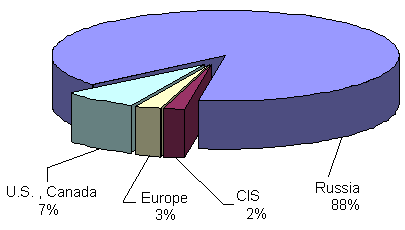
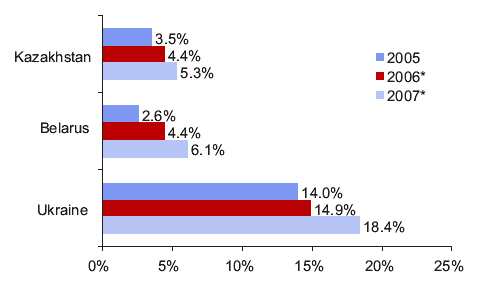
Figure 8. Distribution of headquarters by country and region. Thus, almost 90% of companies have their headquarters in Russia, and about 10% of companies position themselves as non-Russian companies. Outside Russia most headquarters are in North America (the U.S. and Canada), which reflects the high demand for Russian programming services from American companies. Headquarters outside the former Soviet Union do not have as a rule have many developers - mostly the people who work there are managers dealing with client relations. As for distribution of programmers' groups outside Russia, of most interest is information about branches in CIS countries, and plans to open them in the near future. In 2005, the largest concentration of working sub-offices was found in Ukraine (14%). Some of respondents also have offices in Belarus and Kazakhstan. Single mentions were made of Armenia (Yerevan), Latvia (Riga) and Uzbekistan (Tashkent), although no firms planned to open new branches in these countries. Russian companies are branching out further currently only in Ukraine, Belarus and Kazakhstan. In these three countries, the number of subsidiaries is likely to increase by 50% by the end of 2007, with Ukraine staying out in the lead on this indicator.
* - forecast Figure 9. Presence of branches in CIS countries, % Several respondents were able to list sales offices as branches, and not just software development centers. Ukraine and Kazakhstan are markets that are fairly large and fast-growing. However, as the number of clients grows at sales offices (commercial departments), the technical side comes with it, and later a development center may be set up. Companies with a branch network (more than one branch) make up no more than 20% of Russian exporters. Slightly more survey participants (23%) have opened a branch or branches in Russia.
Most branches are concentrated in Moscow and St. Petersburg. Moreover, in Moscow regional firms use the capital's opportunities to be closer to clients. In the regions, most branches belong as a rule to Moscow and Petersburg exporters - although they are not yet using regional resources to the full. |
|
  





|
|
|
|
|
|